
Pakistan does not have press freedom’: Vance reveals what caused delay in releasing full text of US-Iran deal
Both Pakistan and Qatar helped mediate the agreement. Prime Minister Shehbaz Sharif of Pakistan was the first to announce the peace deal.
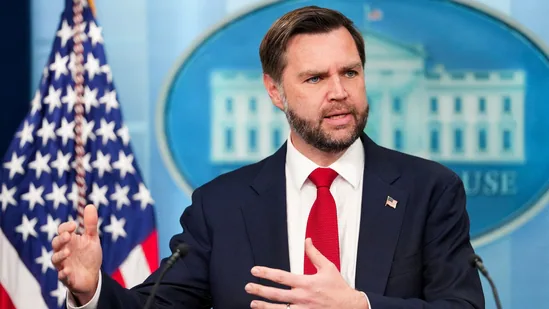
US vice president JD Vance said that the delay in making the complete text of the peace agreement between the United States and Iran public, dubbed the “Islamabad Memorandum of Understanding”, may have been because of the absence of press freedom and First Amendment protections in Pakistan, which acted as a key mediator.
The delay in making Iran deal public
Notably, both Pakistan and Qatar helped mediate the agreement.
Prime Minister Shehbaz Sharif of Pakistan was the first to announce through a social media post earlier this week that the US and Iran had reached a ceasefire agreement, later named the “Islamabad Memorandum of Understanding.”
A senior US official told Bloomberg that discussions held openly with Pakistani authorities and separate private talks with Qatari officials helped the administration understand Iran’s political structure and eventually move the agreement forward.
A late intervention by Qatar ultimately helped secure the temporary agreement, the report added.
Even after the announcement, uncertainty shrouded the deal since the complete text of the 14-point Memorandum of Understanding (MoU) was not made public straight away.
Vance blames lack of press freedom over delay in release
While appearing on The New York Times (NYT) podcast, ‘Interesting Times with Ross Douthat’, the US Vice President blamed the lack of press freedom in the mediator nations as a reason for the delay in publishing the full text of the “Islamabad Memorandum of Understanding”.
During the conversation, Vance faced a question about what the deal delivered for the US and the world that could not have been secured without three months of war.
To this, he replied, “So first of all, we actually really want to get this out because it’s hard to have the conversation without the full text.
And I think part of the misalignment here is that in the Pakistani and Qatari systems, they don’t quite have the First Amendment and freedom of the press, and so there isn’t this expectation that the text is going to be out there for the American people to actually interrogate and look at and analyze and understand for themselves.”